
Turn Your Passion Into a Paid Program: A Feminine-Energy Approach to Starting a Coaching Business
Apr 26, 2026
Starting a coaching business really begins with turning your calling into a clear niche, a simple offer, and a business model that fits your energy instead of draining it. The most sustainable path is moving from idea, to niche, to offer, to pricing, to first clients, while also doing the inner work that keeps you from hiding, undercharging, or overcomplicating everything.
TL;DR - Turn Your Passion Into a Paid Program: A Feminine-Energy Approach to Starting a Coaching Business
This guide walks through how I would start a coaching business from calling to first clients, without hustle or confusion.
Key Takeaways:
- Your calling needs a clear niche.
- Simple offers sell faster than vague passion.
- Pricing reflects confidence and clarity.
- Your business model should fit your unique energy.
- Content identity matters before heavy strategy.
- Inner work blocks can slow execution.
What does it really mean to start a coaching business?

I’m Alexis, and to me, starting a coaching business means creating a clear path for transformation around the thing you feel called to help people with. Passion matters, but passion on its own is not an offer. A business really begins when your gift becomes clear and specific enough for someone to understand, want, and feel ready to pay for.
I always come back to this idea of soul first, then structure. Your idea can be deeply aligned and still need clearer messaging, cleaner packaging, and stronger boundaries around how you deliver it.
How do you find your niche without boxing yourself in?

Finding your niche means getting clear on the problem, person, and outcome you want to be known for first. I don’t see a niche as a prison. It’s a starting point that helps the right people immediately recognize themselves in your work.
Harvard Business School encourages doing market research and competitive analysis before launching a business, which matters because clarity grows faster when you know who you serve, what they need, and how your work is different.
To me, a good niche usually comes down to three simple things:
Who do I help?
What are they struggling with?
What result am I guiding them toward?
When you can answer those clearly, your content, offer, and messaging all start to feel so much easier.
How do you turn your idea into a real offer?

Turning your idea into a real offer means getting clear enough to move from “I want to help women” to "I help this kind of woman get this result through this process”. I want your offer to have a clear promise, a simple structure, and a delivery style that makes sense for the woman you’re here to serve.
This is where I see a lot of women get stuck, because getting specific can feel scary. But clarity is kind. Your future clients need to know what they’re stepping into. Is this a self-paced course, a 1:1 container, a group experience, or a starter program with one clear outcome? Simplicity is what makes your offer feel trustworthy.
How do you choose between a course, 1:1 coaching, and a group program?
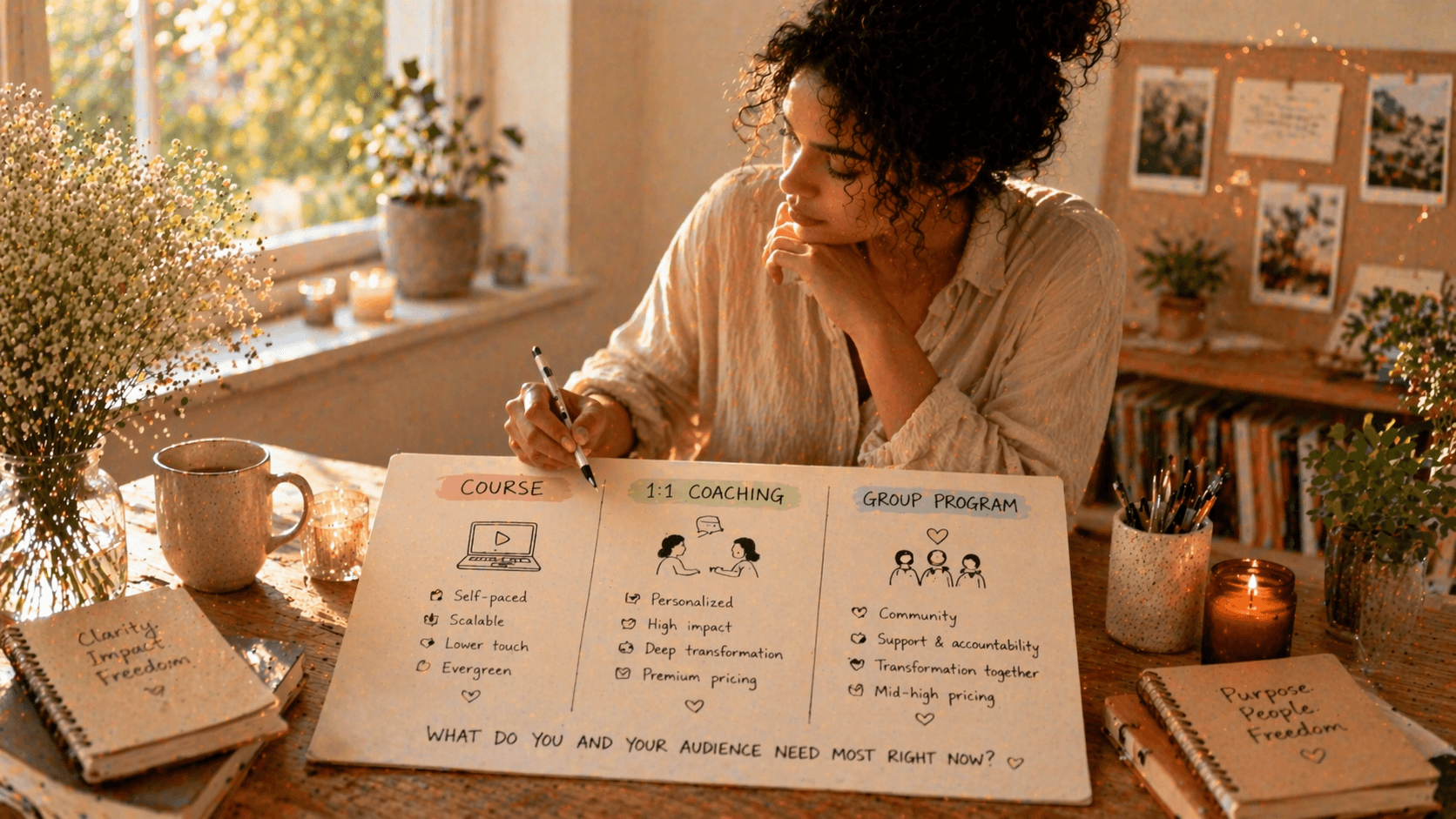
When I think about choosing between a course, 1:1 coaching, and a group program, it really comes down to the kind of support you want to offer, the lifestyle you want to build, and the energy you want your business to require from you.
1:1 coaching gives you intimacy, customization, and faster feedback.
Group programs give you community, shared momentum, and more scalability.
Courses give you flexibility and a business model that feels less tied to your time.
I don’t think there’s a morally superior model here. There’s just the model that fits your season, your nervous system, and your current level of clarity. I’d start with the simplest model you can deliver well.
How do you build pricing confidence?

Building pricing confidence starts with understanding that undercharging does not make your work more feminine, more humble, or more aligned. It usually makes your business shaky and your delivery resentful.
J.P. Morgan recommends writing a business plan because it helps you clarify operations, audience, and finances before you launch, which supports more grounded decisions around pricing and profitability.
Pricing confidence grows when your offer is clear. If you know the result, structure, time investment, and client journey, your price starts to feel less random. You do not need to price from fear. You can price based on clarity, capacity, and the value of the transformation you are holding.
Why does content creator identity matter so much?

Content creator identity matters because people often meet your energy before they meet your offer. If you do not yet see yourself as someone with a message, you will keep hiding behind overthinking, perfectionism, and endless preparation.
I don’t believe you need to become a loud internet personality. I do believe you need to become visible enough for the right people to find you. Your content is where your niche gets sharper, your confidence gets stronger, and your audience starts trusting your voice.
What inner work blocks usually slow women down?

Inner work blocks usually show up as fear of visibility, fear of being judged, fear of charging, fear of being too much, and fear of choosing the wrong niche. These are not just strategy issues. These are identity issues.
A lot of women try to solve identity problems with more information. But if you do not feel safe being seen, no amount of business advice will fully unlock your next level. Inner work is what helps you move from “Who am I to do this?” into “This is what I am called to build.”
What is a simple roadmap from idea to first clients?
If I were helping you go from idea to first clients, I’d keep it simple:
- Get clear on your calling: Name the transformation you feel most called to help women with.
- Choose your niche: Get specific about the woman, the problem, and the outcome.
- Build one clear offer: Pick the easiest format for the season you’re in right now.
- Set grounded pricing: Choose a price that supports your delivery, your boundaries, and your sustainability.
- Create content around one message: Speak to the exact problem your offer solves.
- Invite people into the next step: Make it easy to inquire, apply, or buy.
Your first clients do not need a massive empire. Your first clients need clarity, trust, and a reason to say yes.
FAQs

Do I need to have everything figured out before I start?
You do not need everything figured out before you start. You do need enough clarity to name who you help, what you help with, and what the first offer is. Action sharpens clarity. Waiting for perfect certainty usually just delays the business you are meant to build.
What if I feel called to help with many things?
If you feel called to help with many things, start with the one transformation you can explain most clearly right now. You are not losing the rest of your gifts. You are giving your audience one simple doorway into your world. Expansion can come later.
How do I know my first offer is good enough?
Your first offer is good enough when it solves one real problem for one clear person in a way you can confidently deliver. It does not need to be huge. It does not need to be perfect. It needs to be specific, supportive, and easy to say yes to.
Summary
Starting a coaching business becomes much simpler when you stop trying to build everything at once. Your best next step is to choose a clear niche, package one aligned offer, price it with confidence, and let your identity catch up through visible action.
If you are ready to turn your calling into a real business with feminine energy, inner work, and structure that actually supports your life, begin your journey with The Glowprint. A space where I go deeper into niche clarity, offer creation, pricing confidence, and building a business that feels like you.
.
See you inside!
With love,
Alexis
View The Entire Collection
See all our blog posts on business, feminine energy practices, and designing a life you love.